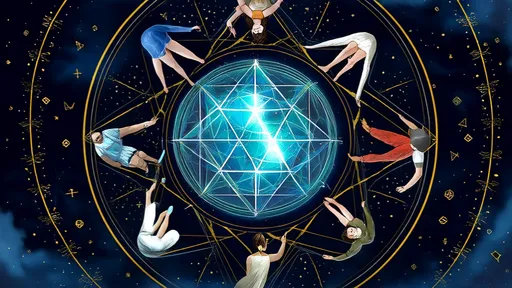
In the ever-evolving landscape of cognitive enhancement and memory manipulation, a peculiar yet fascinating concept has emerged from the intersection of neuroscience and metaphorical imagination: the idea of astrological boundaries in memory editing. This notion, while not rooted in literal astrology, borrows the poetic framework of celestial maps to explore the limits and ethical frontiers of our ability to alter, enhance, or erase human memories. It is a theme that challenges both scientists and philosophers to consider where the lines—much like the borders between constellations—should be drawn in the uncharted territory of the mind.
The human memory has long been compared to a vast, starry sky—each recollection a distant sun, some burning bright and clear, others faint and obscured by time or trauma. Memory editing technologies, ranging from pharmacological interventions to advanced neuromodulation techniques like optogenetics and CRISPR-based approaches, offer the potential to navigate this cosmos with unprecedented precision. We can now target specific neural pathways, weaken undesirable associations, or even implant entirely new narratives. Yet, with this power comes a profound responsibility: to define the ethical constellations that guide our actions.
One might ask: what are these astrological boundaries? They are not physical barriers but symbolic demarcations representing the ethical, psychological, and societal limits of memory alteration. Just as ancient astronomers drew imaginary lines between groups of stars to create myths and meanings, modern ethicists and researchers must delineate where therapeutic intervention ends and manipulation begins. For instance, editing traumatic memories to alleviate PTSD might fall within acceptable bounds, akin to tracing the familiar shape of Orion. But venturing into enhancing academic recall or altering personal identity narratives could cross into uncharted celestial territories, where the risks of misuse or unintended consequences loom large.
The technology itself is advancing at a staggering pace. Researchers have demonstrated the ability to selectively erase fear memories in rodents using optogenetics, while human trials explore drugs that can dampen the emotional intensity of recollections. These tools promise hope for millions suffering from debilitating conditions, yet they also raise unsettling questions. If we can edit memories, who controls the narrative of our past? Could governments or corporations exploit these technologies to shape collective memory or enforce conformity? The stars of this new cosmos—neurons and synapses—must be navigated with care, lest we lose our way in the darkness.
Moreover, the concept of astrological boundaries emphasizes the cultural and individual variability in what constitutes acceptable memory editing. In some societies, preserving authentic personal history might be valued above all, much as certain constellations hold deep cultural significance. In others, the pursuit of cognitive optimization or emotional well-being might justify more aggressive interventions. This relativistic landscape requires a global dialogue, one that incorporates diverse perspectives from ethics, law, neuroscience, and even the arts, to map out these boundaries in a way that respects human dignity and autonomy.
Critics argue that tinkering with memory risks undermining the very essence of human experience. Memories, even painful ones, shape our identity and growth. Editing them might create a sanitized but hollow self, like a star chart with missing constellations. Supporters, however, see it as a natural extension of medicine's goal to heal and improve lives. They draw parallels to other medical advancements—such as antidepressants or surgery—initially met with fear but now widely accepted. The challenge lies in finding a balance, perhaps by establishing clear, transparent guidelines that evolve with both technological capabilities and societal values.
Looking ahead, the development of memory editing technologies will likely force us to confront deeper philosophical questions: What is the nature of self if our past is malleable? How do we maintain trust in personal and historical narratives when they can be altered? These questions resonate with the metaphorical idea of astrological boundaries—they are not fixed but shifting, requiring constant observation and adjustment as our understanding grows. Just as astronomers refine star maps with new discoveries, we must continually reassess the ethical limits of memory editing.
In conclusion, the notion of astrological boundaries in memory editing serves as a powerful metaphor for the ethical complexities we face. It reminds us that while we possess the tools to reach for the stars of cognitive control, we must also chart the constellations of caution, empathy, and wisdom. As we stand on the brink of rewriting the stories in our minds, let us ensure that our navigation through this cosmic expanse is guided not only by scientific innovation but by a profound respect for the human spirit and its inherent right to both remember and forget within bounds that honor our shared humanity.

By /Aug 25, 2025

By /Aug 25, 2025

By /Aug 25, 2025

By /Aug 25, 2025
By /Aug 25, 2025

By /Aug 25, 2025

By /Aug 25, 2025

By /Aug 25, 2025

By /Aug 25, 2025

By /Aug 25, 2025

By /Aug 25, 2025

By /Aug 25, 2025

By /Aug 25, 2025

By /Aug 25, 2025

By /Aug 25, 2025

By /Aug 25, 2025

By /Aug 25, 2025
By /Aug 25, 2025

By /Aug 25, 2025

By /Aug 25, 2025